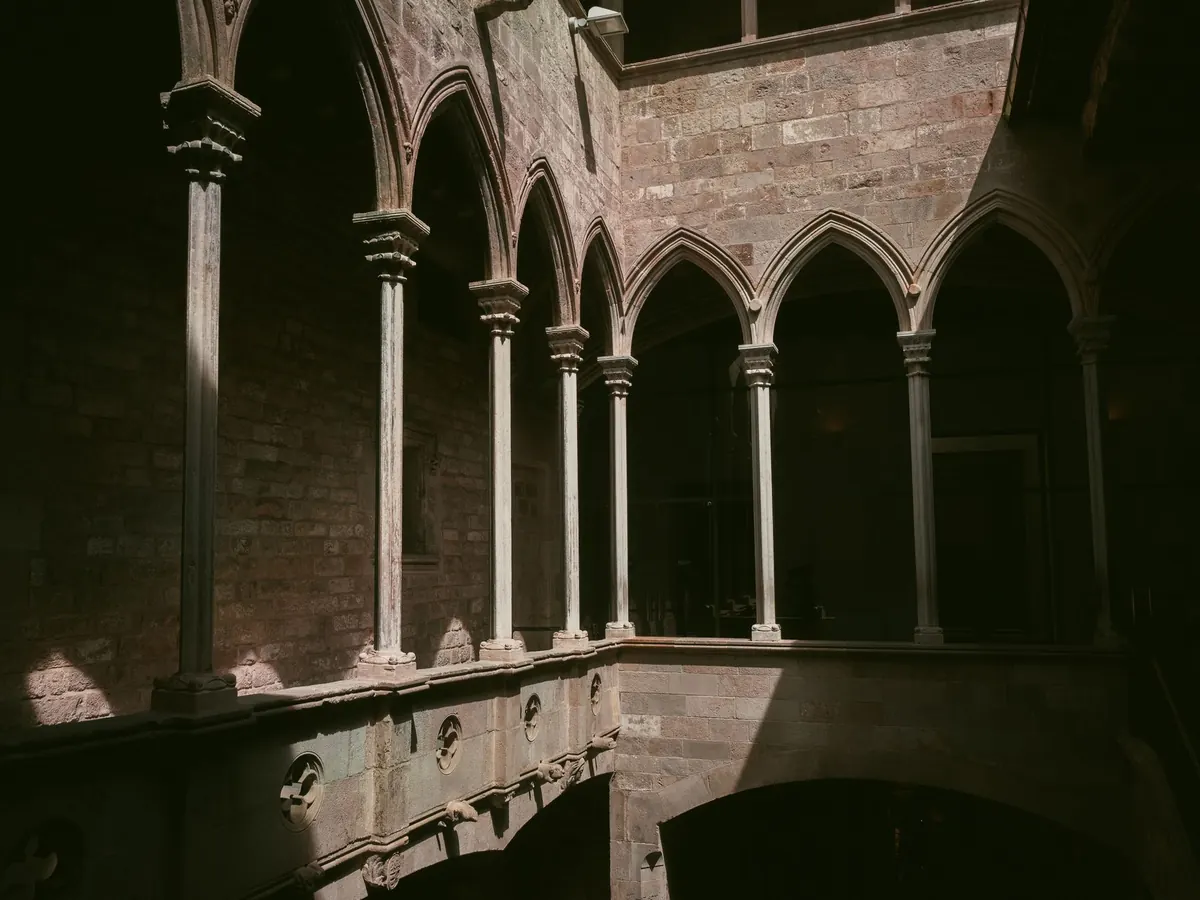
The first sound in a Benedictine monastery is usually a bell, not an alarm. It rings in the dark, and the monks or nuns who hear it get up, wash quickly, and walk to the church. Everything that follows — the psalms, the reading, the soup, the hours in the garden or the bindery — is arranged around that bell.
You don't have to visit a monastery to understand the shape of the day, but it helps to have a map. Monastic life is not mysterious so much as ordered. The same seven or eight gatherings, the same three promises, the same slow accumulation of ordinary tasks: get those right and you have understood most of what happens behind the wall. What follows is that map, written as a checklist you could carry in a pocket.
The Hours: A Checklist of the Daily Office
The Liturgy of the Hours — also called the Divine Office or, in older language, the opus Dei, the "work of God" — is the spine of monastic time. Benedict of Nursia, writing his Rule in the sixth century, assumed that "nothing is to be preferred to the work of God," which is why the bell interrupts everything else rather than the other way around.
Names and times vary by community and season, but a typical Benedictine day looks roughly like this:
- Vigils (or Matins) — around 2:00–4:00 a.m., the longest and quietest office, heavy with psalms and patristic reading. A few communities have moved it to the evening to spare the elderly and the working.
- Lauds — at dawn. Praise, as the name says, with the Benedictus from Luke's Gospel as its centerpiece.
- Prime — early morning. Suppressed in most places after the reforms of the 1960s, but still kept in some monasteries.
- Terce — mid-morning, around 9:00 a.m.
- Sext — midday.
- None — mid-afternoon, around 3:00 p.m.
- Vespers — at sunset, with the Magnificat. Often sung, and often the office most open to guests.
- Compline — before bed. Short, examined, penitential, ending with the great silence.
Notice what the pattern does. It breaks the day into pieces no longer than about four hours, and each piece begins with somebody else's words. A monk does not have to invent a prayer at three in the afternoon; the Church hands him one. That is the point. The hours are not a devotional hobby but a schedule of interruption, and the interruptions are the life.
The Vows: Three Promises, Made Once
Most people arrive at the word "vow" expecting poverty, chastity, and obedience. Those are the evangelical counsels, and they matter — but a Benedictine professes something slightly different, and the difference is worth knowing.
- Stability — a promise to stay with this community, in this place, until death, rather than moving on when the abbot gets difficult or the winter gets long.
- Conversatio morum — usually translated "conversion of life" or "fidelity to the monastic way." It is a vow to keep changing, to let the life keep cutting away what does not belong.
- Obedience — listening, in the literal sense of the Latin oboedire. Not blind compliance so much as a decision to stop treating your own preference as the final word.
Poverty and chastity are woven into conversatio morum. A monk owns nothing privately because the community holds everything in common; celibacy frees the heart for a love that is not narrowed to one household. What holds the three together is that they are made once. Monasticism is not a series of fresh starts. It is one promise, kept on bad days.
We intend to establish a school for the Lord's service. In drawing up its regulations, we hope to set down nothing harsh, nothing burdensome. — Rule of St. Benedict, Prologue
Work: Ora et Labora
The slogan ora et labora — pray and work — is a tidy summary of something messier. In practice, the work of a monastery is whatever keeps the place running and pays the bills: baking bread, brewing beer, keeping bees, binding books, farming, running a retreat house, teaching, caring for the sick, answering the door.
Two features make monastic work different from a job. First, it is interruptible. The bell outranks the project. Whatever you were finishing, you stop. Second, it is unspecialized by status. An abbot may weed the vegetable beds; a former professor may wash pots. In a healthy community the tasks rotate or at least sit lightly, because the work is not the point — the person doing it is.
A Day in Outline
- Rise in the dark; wash; walk to the church for Vigils.
- A short break, then Lauds at first light.
- Personal prayer or lectio divina — slow reading of Scripture, often with a notebook.
- Breakfast, frequently taken in silence.
- Terce, then the morning work period, roughly three to four hours.
- Sext, then the main meal of the day.
- Rest, study, or a second work period.
- None, then afternoon work in the garden, workshop, or office.
- Vespers at dusk, sung when the community can manage it.
- Supper, often light; then recreation or a chapter meeting.
- Compline; then the great silence, kept until after breakfast the next morning.
Food, Silence, and the Small Rulers of the Day
Monastic eating is governed less by diet than by discipline. Many communities keep vegetarian tables, or serve meat only to the sick and to guests. Fasts are set by season — Advent and Lent being the heaviest — and hospitality regularly overrides them, because the Rule tells the monastery to receive every guest "as Christ." Feast days bring cake; that is not a contradiction, it is the calendar breathing.
Silence deserves its own heading. It is not the absence of noise but the presence of attention. In Benedictine houses it is thickest at night, after Compline, and lightest during recreation, when speech is expected and even cheerful. Visitors who expect grim mutes are usually surprised. What they hear instead is a quietness that has permissions built into it.
What a Visitor Actually Notices
- Shoes squeaking on stone, and no one talking.
- Clocks that matter less than bells.
- A very old psalter with greasy corners.
- Someone working at the same task they were working at a decade ago, content.
- Guests fed first, and better.
Keeping the Clock Without the Habit
You can borrow the architecture without taking the vows. Choose two fixed points in your day — first light and dusk work well — and keep them. Stop once mid-morning and once mid-afternoon for three minutes of silence. Do one task that no one will notice. Keep a promise you made to someone you see every day.
The bell is not really about waking up. It is about being called out of yourself and into a shared life, at a time you did not choose, alongside people you did not pick. That much travels.
Photo: Mariya Eskina / Pexels