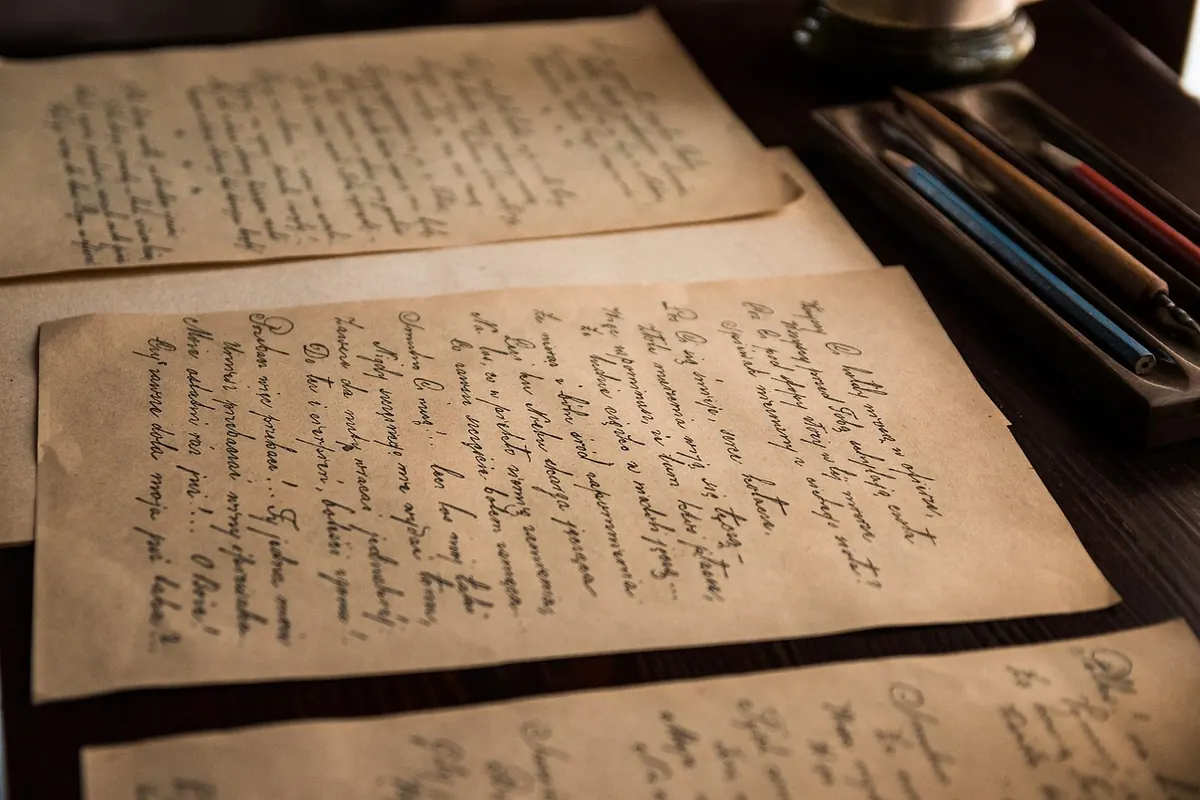
A charter is not a book. It is a single sheet of parchment — or two, or three sewn together at the foot — covered in tightly packed Latin and closed with a seal. Somewhere in that wall of strokes is a name, a place, a date, and a set of boundaries that once mattered enormously to the people who paid to have them written down. Learning to read one takes less genius than patience. The script is regular, the wording is formulaic, and the same words return again and again. Crack one charter and you have cracked a hundred.
Know What You Are Holding
Two disciplines meet here. Palaeography is the study of old handwriting; diplomatics is the study of a document's form — its clauses, its sealing, its legal habits. You need both, because a charter's script and its structure explain each other.
Most charters record a legal act: a grant of land or rights, a lease, a quitclaim, a confirmation of an earlier gift. Some are originals, written on the day; others survive only as copies entered into a cartulary, the great register books kept by monasteries and cathedrals. Copies may tidy up awkward spelling, drop witnesses, or quietly improve a donor's generosity. Treat them as evidence, not as transcriptions.
Watch, too, for the chirograph: a single sheet cut in a wavy line across the middle, with the word cyrographum written over the cut, so that each party held a half that could later be matched. And keep a mild scepticism ready. Charters were forged, sometimes very well, when a monastery needed to prove a right it had lost.
Use the Formula Before You Use Your Eyes
Charters follow a predictable order, and knowing it lets you guess at a word before you can actually read it. A solemn royal or episcopal charter usually runs:
- An invocation, such as In nomine Patris et Filii et Spiritus Sancti
- The grantor's name and title — Henricus Dei gratia rex Anglie
- A general address — omnibus fidelibus suis, archiepiscopis, episcopis, abbatibus
- A notification — Sciant presentes et futuri quod… or Noverint universi…
- The dispositive clause: what is given, to whom, and on what terms
- Boundaries, if land is involved
- The witness list — Hiis testibus
- The dating clause — Data apud… or Actum…
Once you recognise Sciant presentes et futuri quod, you know the next clause will name the grantor in the nominative. That is a huge advantage when a scribe has squeezed six minims into the space of three.
The Letter Forms That Trip Everyone Up
Medieval scribes wrote in several families of script — Caroline minuscule, Textura, Anglicana, Secretary — and English documents after the Norman Conquest often mix them. A few habits cause most of the trouble:
- Minims. The letters i, n, m, u are all short vertical strokes. The word minimum is exactly as bad as it sounds. Count strokes, and use the surrounding Latin to decide which letter is meant.
- Long s (ſ). It looks like an f without the crossbar. Round s usually appears at the end of a word.
- Thorn (þ) and yogh (ȝ). Thorn is the th sound; yogh covers several sounds we now spell y, g or gh. Both appear in English-language documents.
- Interchangeable pairs. u and v, and i and j, were not yet distinct. Iustus, ius, uersus and versus are all the same habit.
- Doubled letters. A capital F is often written ff. In English charters, w may appear as uu or vv.
- Tall and short c, t and e. In fast cursive hands these can collapse into each other. Read the word aloud in Latin; the ear will correct the eye.
Abbreviations Are Not Decoration
Scribes saved parchment, and abbreviation was a professional skill. Most marks fall into two kinds. A suspension cuts a word short and flags the loss with a horizontal stroke above it. A contraction keeps the first and last letters with something in between. Familiar examples:
- A stroke over a letter stands for a missing m or n: dñs for dominus, n̄r̄e for nostre.
- p with a stroke through the descender means per, pre or par: p̄dctus for predictus, p̄fat̄us for prefatus.
- The Tironian mark, shaped like a 7, means et.
- Superscript letters supply endings: ao for anno, dni for domini.
- Sacred names are abbreviated by convention: ihs for Iesus, xpc for Christus, sps for Spiritus, eps for episcopus.
Transcribe exactly what you see, then expand in square brackets: p̄dctus becomes p[re]dictus. Keep a running list of the marks in your document. Scribal habits are personal, and the same flourish will come back within a page.
The Dating Clause Is Your Anchor
Dates in charters rarely arrive as a plain day, month and year. They are built from layers, and each layer is a chance to check the others.
Regnal years
A king's reign supplies the year: anno regni regis Henrici tertii vicesimo — the twentieth year of Henry III. Reigns were usually counted from accession, though practice varied, so convert with a reference table rather than trusting memory.
Saints' days and the church calendar
Many dates are given by feast: in crastino Purificationis is the morrow of the Purification, 3 February. Look also for vigils (the day before) and octaves (a week after). A good calendar of saints' days is an essential tool; get one before you start.
Kalends, nones and ides
Older documents use Roman reckoning, counting backwards towards the next named day. The day before the kalends of April is 31 March. The count is inclusive in a way that catches beginners, so check each date against a conversion table.
Indictions and the start of the year
An indiction number places the document in a fifteen-year cycle and can rescue a damaged date. Be warned that the year itself did not always begin on 1 January: in England the legal year began on 25 March, so a charter dated in January or February may belong to the following calendar year by modern reckoning.
A Method That Works
- Work from a good image or the original, in daylight, at larger than life size. No filters; they hide faint strokes.
- Transcribe line by line, exactly, including abbreviations. Do not translate yet.
- Read the transcription aloud as Latin. Sound resolves ambiguous letters.
- Expand abbreviations in square brackets and mark illegible letters honestly, as […]. Never guess silently.
- Identify the clause you are in. Formula confirms reading.
- List names, places and the dating clause separately, then verify the date against the witness list and the regnal year.
- Compare your text with any printed edition or calendar of the document, if one exists. Where you differ, work out who is right.
Ten Lines a Day
Start with something large and legible: a royal charter of the thirteenth century, or a well-photographed monastic original from a national collection or county record office. Many archives and university libraries publish digitised charters and free tutorials in reading old documents; use them as practice ground. Keep a notebook of letter forms and abbreviations you meet, dated and attributed to the document.
Ten lines a day is enough. Palaeography rewards repetition more than talent, and the moment a cramped line of strokes suddenly resolves into Sciant presentes et futuri quod ego… is the moment the whole exercise becomes addictive.
Photo: Ylanite Koppens / Pexels